
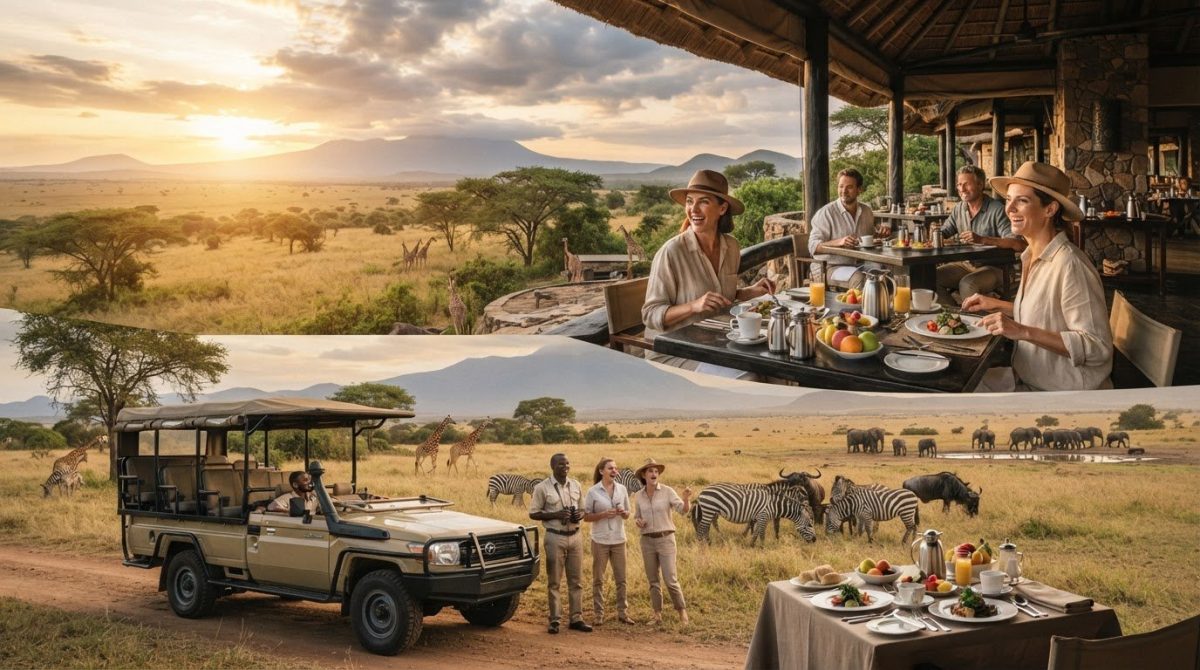
“All inclusive” doesn’t always mean every drink and activity is covered. An all inclusive Tanzania safari typically bundles accommodation and meals, while drinks, game drives, and other activities depend on the itinerary and camp or lodge. International flights aren’t included as standard, so review the package inclusions before you travel.
Looking beyond the label helps you plan with confidence and avoid surprises. This guide explains what to check for accommodation, meals, beverages, transfers, and activities, and how to compare safari options across Tanzania and other African destinations.
You’ll also learn how the Great Migration shapes travel timing, which routes connect the Serengeti, Ngorongoro, and Tarangire, and how to choose an itinerary that fits your priorities. Whether you’re drawn to wildlife, comfort, or a safari and beach combination, these details help you picture the trip before choosing a route.
Key Takeaways
- Separate international flights from the safari package, then look closely at how the itinerary treats drinks, game drives, and optional experiences.
- Use migration timing to shape your route: southern Serengeti calving takes place from January to March, while northern river crossings are associated with July and August.
- Compare accommodation, meals, beverages, transfers, and camp activities individually; “all-inclusive” can cover different elements from one stay to another.
- Plan how Serengeti, Ngorongoro, and Tarangire fit together, balancing wildlife priorities with travel time between parks.
- Consider how Tanzania’s safari and beach experiences compare with other African destinations when deciding what kind of trip you want.
Are drinks and activities included in an all-inclusive safari in Tanzania?
Luxury stays generally offer more comfort, while mid-range and budget packages use simpler accommodation and may include fewer extras. International flights aren’t included as standard. Airport transfers and park fees depend on the itinerary’s stated inclusions.
Included Flights, Hotels, Tours, and Transfers
Read the itinerary line by line: distinguish international flights from domestic connections, then identify each hotel, camp, or lodge. Safari camps and lodges commonly bundle accommodation and meals, while hotels often offer bed-and-breakfast rates. Look for named tours, game drives, and transfers, and check each against the listed inclusions rather than relying on the package label.
Domestic bush flights can connect remote safari areas, but whether they’re included depends on the itinerary. A route linking northern Serengeti camps may use an airstrip transfer, while a road-based journey may travel between parks by vehicle. Compare the stated route with the listed transport, and note where each flight or road transfer begins and ends.
Check drinks and activities separately. “All-inclusive” doesn’t guarantee that every beverage or optional experience is covered, so look for details about drinks, guided game drives, and camp activities. A balloon safari or a Zanzibar beach extension may be a separate itinerary choice, not an automatic part of a wildlife-focused stay.
Airport Transfers and Return Flights
Separate the international journey from the safari’s ground arrangements. International flights aren’t included as standard, while airport transfers may be part of the package. Identify the arrival airport, transfer destination, and starting point for the return journey. This makes it easier to see whether the itinerary connects the airport, lodge, and final departure.
For your return flight, trace the itinerary from the final camp to the airport. Depending on the route, it may include a road transfer, a domestic flight, or both. Locate park fees as a separate item in the package details; don’t assume “all-inclusive” means they’re covered.
Pack for the transport shown. Bush flights in Tanzania typically allow 15kg in a soft bag, so a rigid suitcase may not suit the flight. Keep essentials compact, and organize clothing for game drives, lodge stays, and any planned beach time in Zanzibar. Match your bag to the bush-flight limit before departure.
Compare packages in three steps: identify what’s included, separate optional experiences, and trace every transfer from arrival to departure. This clarifies what your safari covers, from a lodge stay and meals to a flight between parks or an excursion beyond the standard route.
02 What is the Great Migration and when does it happen?
The Great Migration is the seasonal movement of wildlife between Tanzania’s Serengeti and Kenya’s Masai Mara. The herds move across the landscape, so the best place to watch depends on the season and the wildlife moment you hope to see. Plan around a region and seasonal event rather than expecting the herds to stay in one place.
The movement includes roughly 1.5 million wildebeest, 400,000 zebra, and 200,000 gazelle. More than 2 million ungulates live in Tanzania’s Serengeti National Park. These numbers help explain why an all inclusive Tanzania safari focused on migration highlights broad areas and changing herd movement, rather than a single fixed viewing point.
For newborn wildlife, focus on the southern Serengeti. Calving season takes place from January to March, when herds gather in the calving grounds. Safari itineraries also describe the Serengeti calving season as December to March. This wider window can help with trip planning, while the southern Serengeti is the key area for the January-to-March calving period.
For river crossings, look north. The northern Serengeti in July and August is identified as a place and time to see crossings. Itineraries also describe July to October as the Northern Serengeti crossing season. Choose a route that spends time in the north during the period you’re targeting.
Serengeti game drives make migration viewing an unfolding experience. Guides can follow fresh signs and changing herd locations across the park, and each drive offers a different chance to observe wildlife. A migration sighting isn’t a fixed appointment: the herds move, so allow time in the Serengeti region relevant to your trip.
Wildebeest migration safaris work best when the itinerary connects timing with geography. A calving-focused journey points toward the southern Serengeti; a crossing-focused plan points north. If you also want to visit another park, balance that addition against time in the region tied to your migration priority. For a closer look at seasonal timing and how it can shape your route, explore this Serengeti migration safari timing and Tanzania itinerary.
Plan travel logistics alongside wildlife timing. An airport arrival, onward transfer, or domestic flight can affect how much time remains for game drives. Keep the first and final travel days in view when comparing itineraries, so your Serengeti stay aligns with the season you’ve chosen rather than becoming a brief stop between transfers.
Before choosing, decide whether calving or river crossings matter most, then compare each itinerary’s Serengeti locations and dates. For help exploring a route centered on seasonal wildlife movement, browse Lights on Africa Destinations & Safaris migration planning.
Included accommodation, meals, beverages, transfers, and activities
Compare each stay by accommodation type, meal plan, drinks, transport, and scheduled activities. “All-inclusive” can cover different elements at safari camps, lodges, resorts, and hotels.
Safari Accommodation and Meals
Safari camps, lodges, and resorts commonly offer all-inclusive accommodation packages, while hotels usually offer bed-and-breakfast rates. Compare each property and meal plan, especially when a route moves between Arusha, the Serengeti, and the Ngorongoro Crater. Changing accommodation can also change which meals are covered.
Read the itinerary stop by stop. For each accommodation, identify which meals are included and whether the package covers every overnight stay. This helps you spot differences between a lodge-based safari and a route that uses hotels between park visits. “Luxury” describes a category, not a complete meal plan, so compare the inclusions listed for each stay.
Meal arrangements matter on long game-drive days, too. Note which meals are listed at each camp, lodge, or hotel, and how they fit the planned schedule. Dining arrangements near the Ngorongoro Crater may differ from those for a night in Arusha, so review each location rather than assuming one rule applies throughout.
Included Beverages, Transfers, and Activities
Check beverages separately from meals. Package descriptions may distinguish drinks from food, so look for the beverage inclusions stated for each camp or lodge. Apply the same close reading to transfers: trace the route between accommodation, parks, and departure points, and note which legs are included.
Activities are another distinct item. Wilderness Tanzania safari packages include twice-daily scheduled camp activities, but the specific activity depends on the camp schedule. Compare these options with your planned game drives and any additional experiences to see what’s part of the stay and what’s a separate choice.
Use a checklist for each stop: accommodation, meals, beverages, transfers, and activities. For example, a Serengeti lodge stay may list meals and camp activities, while transport between the lodge and another park appears elsewhere in the route. Keeping these items separate clarifies what the package covers without relying on its label.
Luxury Accommodation
Compare luxury safari stays by location, accommodation type, meal plan, and included activities. Check how many nights the itinerary places in each camp or lodge, and how that location connects with parks such as the Serengeti or Ngorongoro Crater. The property name and listed inclusions tell you more than the word “luxury” alone.
For a practical comparison, set accommodation details beside the daily route. A lodge near a park can shape the rhythm of game drives, while an Arusha hotel may serve a different purpose in the journey. Check the meals and transfers attached to each stay, then compare the complete itinerary rather than judging accommodation in isolation.
The biggest differences between luxury packages may lie in the combination of locations and inclusions, not just the room category. Match your priorities, such as time near the Serengeti or a particular camp activity, with the route and stated meal plan. This gives you a clearer picture of comfort, daily logistics, and what each stay adds to the safari.

Safari itineraries combining Serengeti, Ngorongoro, and Tarangire
Combining Tarangire National Park, the Ngorongoro highlands, and Serengeti National Park creates a classic northern Tanzania route. Choose the order by weighing your wildlife priorities, seasonal location, and travel time between destinations.
Start with your main interest. For Serengeti migration viewing, align the northern Serengeti with the July-to-October river-crossing season, or consider the December-to-March calving grounds. Ngorongoro Crater adds a distinct landscape, while Tarangire brings another park into the route. Your priorities determine how much time to assign to each destination.
Travel time shapes the experience as much as the map. The drive from Tarangire toward the next safari destination is estimated at 3 hours. The journey toward the Ngorongoro highlands is estimated at 2 hours, while travel toward the Serengeti is estimated at 3.5 hours. Use these estimates to understand the rhythm between parks, rather than treating each transfer as a game-drive day.
Ngorongoro offers a concentrated wildlife experience within a dramatic setting. The itinerary describes the crater descent as 2,000 feet. Plan the crater visit as a specific part of the route, not simply a stopover between Tarangire and the Serengeti. The sequence can affect where you stay before and after the descent.
A Tanzania safari of at least 7 nights allows time to visit two or three parks without feeling rushed. A 10-day itinerary can use that principle to connect Tarangire, Ngorongoro, and Serengeti, while allowing more flexibility around travel and park time. Treat the route as a framework: give priority to the park linked to your main wildlife interest, then fit the remaining destinations around it.
For a practical route-planning exercise, compare each itinerary in this order:
- Wildlife priority: identify whether the Serengeti migration, Ngorongoro Crater, or Tarangire matters most.
- Season and location: match the Serengeti region with the migration period you want to target.
- Transfers: account for the estimated drives between Tarangire, the highlands, and the Serengeti.
- Park balance: use the available nights to avoid squeezing three destinations into an overly rushed route.
Ten to fourteen nights is presented as the ideal length for most Tanzania safari travelers, while shorter trips can focus on one area. If your plans connect through Nairobi, consider how arrival and onward travel affect the time available in the parks. A well-paced itinerary makes travel between destinations part of the experience while keeping your chosen wildlife focus at its heart.
All-inclusive safari destinations in Africa
Africa offers several iconic safari settings, each suited to a different trip. Compare wildlife priorities, landscapes, cultural experiences, and the possibility of adding beaches. Then choose a route whose destinations and pace match the experience you want, rather than choosing by name alone.
Tanzania combines game viewing, cultural encounters, and beaches. Zanzibar lies just off the country’s coast, making a mainland safari and island stay a natural pairing. Domestic flights from Arusha or Serengeti airstrips to Zanzibar take under two hours. One sample plan is a one-week Tanzania safari followed by four or five days on Zanzibar. This combination suits travelers who want time among wildlife and by the sea.
Kenya’s Masai Mara is another compelling wildlife destination. Resident animals support game viewing throughout the year, so it can appeal beyond a single migration-focused season. Compare this resident wildlife experience with Tanzania’s Serengeti migration, where timing and the herds’ location shape the route. For a trip centered on iconic wildlife movement, the seasonal destination matters as much as the country.
Botswana offers a different emphasis: enormous reserves with stable, year-round populations of plains game and the Big 5. It also has around 600 bird species, including rare migratory birds. That breadth can suit travelers who want varied wildlife and birdlife, rather than building the entire itinerary around one event. Consider which experiences you most want from the days in the reserves.
South Africa’s Kruger National Park is home to the Big 5, making it a strong option for travelers who prioritize those animals. For a safari with a landmark ending, Victoria Falls can serve as an endpoint in Zimbabwe or Zambia. These destinations create different itinerary possibilities, so compare the wildlife focus with the wider journey you want.
Use these questions to narrow your safari destination:
- Choose Tanzania for a mainland safari that can pair with Zanzibar beaches and cultural encounters.
- Consider Kenya’s Masai Mara for resident wildlife and year-round game viewing.
- Look to Botswana for reserves, plains game, the Big 5, and birdlife.
- Choose South Africa’s Kruger National Park when the Big 5 are a central priority.
- Include Victoria Falls as a possible endpoint for a Zimbabwe or Zambia itinerary.
Match the destination to your preferred wildlife, then compare how each itinerary connects its parks, reserves, and possible beach or landmark stays. This gives you a practical way to choose among Africa’s distinctive safari experiences.
Lights on Africa Destinations & Safaris: 8-Day Luxury All Inclusive Tanzania Safari
Lights on Africa Destinations & Safaris can help turn your preferred parks, pace, and accommodation style into a Tanzania safari itinerary. Its 8-Day Luxury All Inclusive Tanzania Safari suits travelers seeking a guided luxury journey, while the 8Days Tanzania Private Guided Family Safari offers a family-focused alternative.
Choose the Serengeti Migration Safari if seasonal wildlife movement is central to your plans, or the 7 Days Big Five Safari to focus on iconic wildlife. Tailor-made itineraries allow routes, accommodation, and optional activities to be customized around your priorities. This is a useful next step once you’ve decided which destinations and experiences matter most.
Share your travel priorities with Lights on Africa Destinations & Safaris, or visit lightsonafrica.com to explore your safari options.
Shape Your Safari Around What Matters Most
Start by picturing the experience you want to take home. An all inclusive Tanzania safari can be shaped around the landscapes, wildlife encounters, and daily pace that matter to you. Decide which moments matter most, then use those priorities to guide your route and style of stay.
Lights on Africa Destinations & Safaris can turn those preferences into a considered itinerary. Whether you’re imagining a comfortable escape, a family journey, or time centered on wildlife, begin with what matters most to you. Clear priorities make it easier to shape a personal trip, rather than simply assembling destinations.
Take the next step and share the kind of safari you have in mind. Contact Lights on Africa Destinations & Safaris to begin planning, and look forward to discovering Tanzania in a way that feels truly your own.
Frequently Asked Questions
How do I choose the right Tanzania safari for me?
Choose your safari by matching the route to your main interest, travel style, and preferred pace. For example, prioritize time in the Serengeti if migration viewing matters most, or choose a family-focused itinerary if you’re traveling with children. Then consider how long you want to spend in each park, your preferred accommodation style, and whether cultural experiences or a beach stay belong in your plans. These choices help shape a more personal itinerary.
What vaccinations do I need for Tanzania?
Yellow fever vaccination is required for travelers arriving in Tanzania from a yellow fever endemic country and is strongly recommended for all travelers. Consult a travel health clinic at least 6-8 weeks before departure about malaria prevention and vaccinations. Your destination history, planned activities, and health needs help determine the advice that applies to you. Carry your vaccination records with your travel documents, especially if your route includes countries with different entry requirements.
Can I combine a Tanzania safari with Zanzibar?
Yes, you can combine a mainland safari with a Zanzibar beach stay. Domestic flights from Arusha or Serengeti airstrips to Zanzibar take under two hours, making the island a practical addition to a wildlife itinerary. Decide whether you want beach time after game drives or a shorter island visit between travel stages. Include the transfer in your itinerary so the island portion feels like part of the journey, not a rushed extra.
What should I pack for a Tanzania safari?
Pack light, comfortable clothing for changing days outdoors, plus a warm layer for cooler mornings and evenings. If your itinerary includes a bush flight, use a soft bag and keep luggage within the typical 15kg limit. Bring practical sun protection, personal medication, and a small day bag for essentials during outings. A camera and binoculars can also help you enjoy wildlife viewing, while neutral, comfortable clothes work well for time in the vehicle.
Do I need travel insurance for a Tanzania safari?
Travel insurance is a sensible part of planning a remote safari, especially when medical care may require evacuation. Review whether your policy addresses medical treatment, evacuation, trip interruption, and activities planned for your itinerary. Keep policy details and emergency contacts accessible, both digitally and in a separate copy with your travel documents.
Are flights part of the all-inclusive package?
International flights aren’t included in Tanzania safari packages as standard. Domestic flights between safari areas may be part of a particular itinerary, while road transfers may cover other legs. Trace the journey from arrival through the parks to departure, distinguishing international air travel from flights within Tanzania. This helps you plan connections and understand which transport segments are part of the safari arrangement.
What is included in an all-inclusive Tanzania safari package?
An all inclusive Tanzania safari package may combine accommodation, transportation, and guided experiences, with the exact arrangement shaped by its itinerary. Review each overnight stay, meal plan, drink provision, transfer, and activity separately. For instance, a guided game drive may be part of the planned experience, while a balloon safari is a distinct activity to consider. Reading the itinerary this way makes the package’s scope clearer.
What are the best all-inclusive safari lodges and camps in Tanzania?
The best lodge or camp for you is one that fits your route, wildlife priorities, comfort preferences, and meal needs. Compare each stay’s location with the parks you want to visit, then review its accommodation style and stated inclusions. A camp suited to a migration-focused itinerary may not fit a route centered on other parks. Judge the full itinerary, not just the property name or luxury label, to find the right match.