
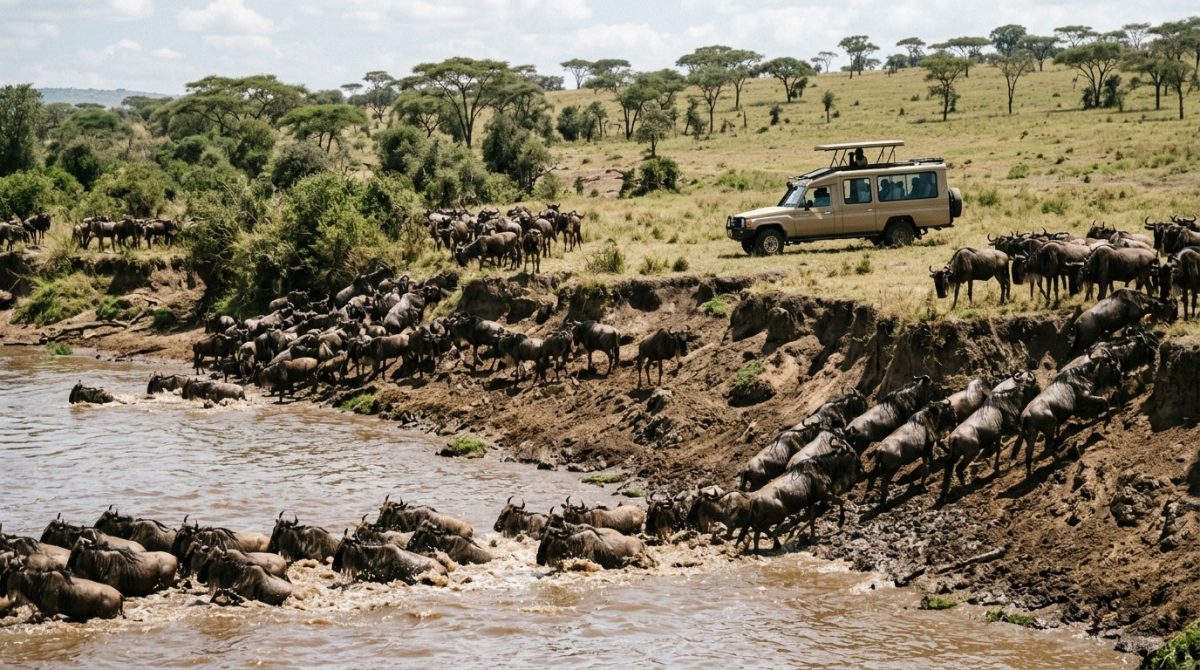
The obvious choice may be the wrong one: how to choose between Serengeti and Masai Mara depends on the landscape and wildlife season you want. The Serengeti covers approximately 14,750 square kilometres, while Kenya’s Masai Mara covers around 1,510 square kilometres. Choose the Serengeti for a vast setting where the Great Migration moves through different areas year-round, or the Mara for its main migration viewing season from June to October.
Both parks are part of the same remarkable wildlife journey, so it’s natural to wonder which one is right for your safari. This guide compares their landscapes, access, and seasonal wildlife viewing, from calving season in the Serengeti to migration months in the Mara. Use these differences to match your travel dates and preferred safari experience to the park that suits you best.
Key Takeaways
- Match your travel dates to the wildlife experience you most want, from calving activity to dramatic river crossings.
- Choose between the Serengeti’s expansive landscapes and the Mara’s more concentrated wildlife viewing based on the pace and scenery you prefer.
- Compare journey times from Arusha and Nairobi when deciding which park fits your itinerary more comfortably.
- Consider a Tanzania-focused migration safari if the Serengeti best matches your season and safari priorities.
Serengeti vs Masai Mara – Which Park Should You Visit?
Park entrance fees and conservation charges are separate from accommodation and safari costs. Include both when comparing itineraries, as the amounts depend on the park and visit details. To choose based on wildlife, consider your travel dates and whether you prefer the Serengeti’s wider migration journey or the Mara’s seasonal concentration of herds.
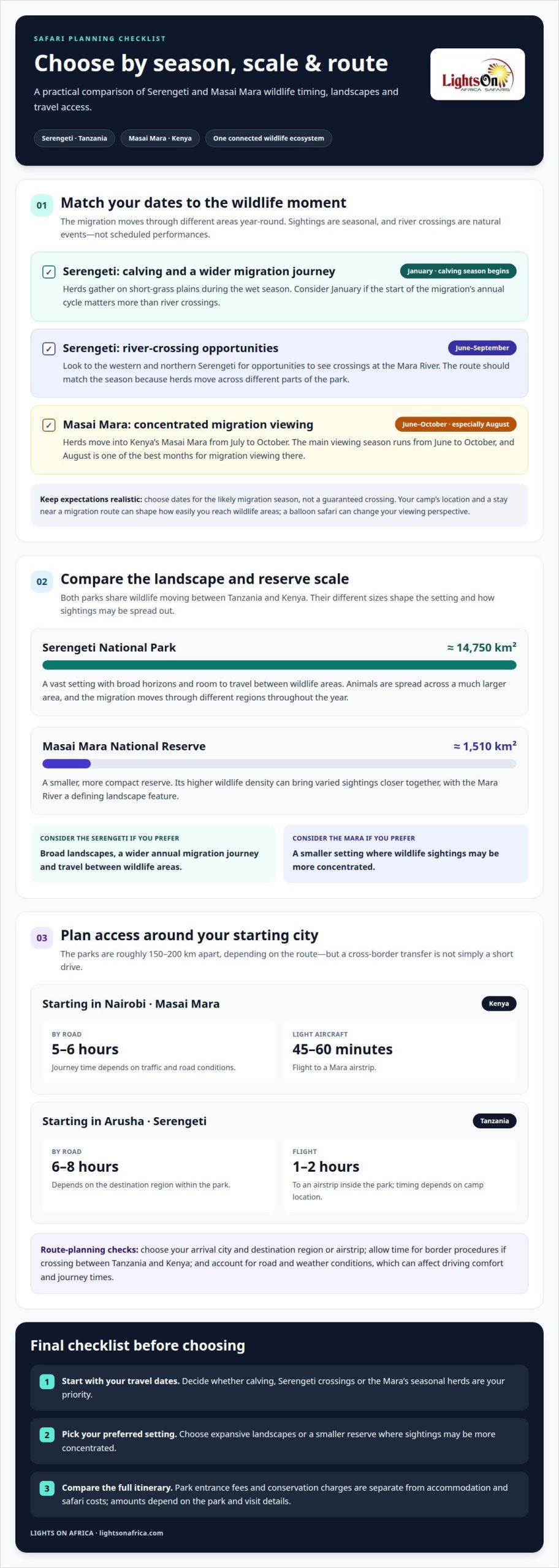
The Great Migration involves millions of wildebeest, zebras, and gazelles moving between Tanzania and Kenya. Calving season begins in the Serengeti, where herds gather on short-grass plains during the wet season. January is worth considering if seeing the start of the migration’s annual cycle matters more to you than river crossings.
For river crossings, timing and location matter. From June to September, the western and northern Serengeti offer opportunities to see crossings at the Mara River. Herds move into Kenya’s Masai Mara from July to October, and August is one of the best months for migration viewing there. Since the migration travels through different parts of the Serengeti throughout the year, match your safari route to the season.
| Option | Migration timing | Best fit |
|---|---|---|
| Serengeti | Calving season; crossings from June to September | Seasonal movement across varied landscapes |
| Masai Mara | Main viewing season from June to October | Kenya’s migration season, especially August |
River crossings are natural wildlife events, not scheduled performances, so choose dates for the likely migration season rather than a guaranteed sighting. A balloon safari or a stay near a migration route can shape your day, while your accommodation’s location affects how easily you can reach the wildlife areas you want to see.
To choose between the Serengeti and Masai Mara, start with your travel dates, then decide whether calving, river crossings, or the Mara’s migration season is your priority. Choose the Serengeti for a broader annual migration journey, or the Kenyan reserve if your plans align with its seasonal herds.
Serengeti and Masai Mara ecosystem similarities and landscape differences
These Tanzania and Kenya destinations share a connected wildlife ecosystem, but their different scales shape the safari experience. Compare the Serengeti’s expansive plains with the Mara’s smaller reserve to decide which landscape suits you.
Shared Ecosystem Features
The Serengeti and Masai Mara are part of one ecosystem, with wildlife moving across the border between Tanzania and Kenya. Both parks can therefore offer encounters with migrating herds and the predators that follow them. The choice is less about which park has the wildlife and more about the setting and scale in which you want to see it.
Seasonal changes affect where animals gather across both parks. The Serengeti’s short-grass plains are important during the wet season, while the Mara River is a defining feature of the Kenyan reserve. When planning your safari, decide whether you prefer broader landscapes or a more concentrated viewing area, then match your itinerary to that preference.
Landscape and Terrain Differences
The Serengeti National Park covers approximately 14,750 square kilometres; Kenya’s Masai Mara National Reserve covers around 1,510 square kilometres. That contrast is central to comparing these destinations. The Serengeti’s greater area gives the journey a wider sense of scale, while the smaller Mara offers a more compact reserve to explore.
Wildlife is less densely concentrated across the Serengeti than in smaller reserves such as the Mara, partly because animals are spread over a much larger area. The Mara’s higher wildlife density can bring varied sightings closer together. Consider the landscapes you want to experience between sightings, not just the animals you hope to see.
Use the landscape to guide your choice: favor the Serengeti for broad horizons and room to travel between wildlife areas, or the Mara for a smaller setting where sightings may be more concentrated. A balloon safari can add a different perspective above either landscape, while your accommodation location helps shape daily access to viewing areas. If you’re weighing Tanzania against other Tanzania safari destinations, start with the scenery and wildlife experience you most want.
Getting to each park
Access depends on whether you begin in Nairobi for Kenya’s Masai Mara or Arusha for Tanzania’s Serengeti National Park. The parks are roughly 150 to 200 kilometres apart, depending on the route, but that distance doesn’t make a cross-border transfer a simple drive. Plan around your arrival city, the park you’ll visit, and whether your itinerary crosses between countries.
From Nairobi, driving to the Masai Mara takes about 5 to 6 hours, depending on traffic and road conditions. A light-aircraft flight to a Mara airstrip takes about 45 to 60 minutes. From Arusha, driving to the Serengeti takes about 6 to 8 hours, depending on the destination region; flights to airstrips inside the park take about 1 to 2 hours, depending on camp location.
Choose your travel mode by weighing time against the experience you want. Driving offers a ground-level journey, while flights shorten transfers to a reserve or lodge near your wildlife-viewing area. In the Serengeti, the destination region matters: the park’s vast plains and grasslands mean your camp’s location shapes the onward journey. In the Mara, choose an airstrip or road transfer that suits your accommodation and planned game viewing.
Visa, health, and border requirements depend on your passport and route. Identify every country on your itinerary and allow time for border procedures when planning a transfer between Tanzania and Kenya.
Road and weather conditions can affect driving comfort and journey times in both destinations. Estimates for the drive from Nairobi to the Mara, for example, vary with traffic and road conditions. Build flexibility into transfer days, especially if you are connecting with a flight or scheduled activity. Follow local guidance during road travel and wildlife viewing, and keep a respectful distance from animals.
Let the route help decide: choose the park that best fits your arrival city and preferred transfer, then match your lodge location to the wildlife areas you want to explore. If you want to visit both countries, allow for the cross-border journey rather than treating the parks as neighboring stops.
Seasonal wildlife viewing
Plan around the experience you want most, because the season affects where wildlife gathers across the Serengeti ecosystem. January to March is calving season in the Serengeti, when wildebeest calves are born and predators, including cheetahs, may be seen nearby. In the green season, rain supports fresh grazing on the plains, drawing herds to short-grass areas.
During January, February, and March, about 200,000 wildebeest and plains-game calves are born in the Serengeti. Around 8,000 baby wildebeest are born each day during calving season. Those figures help explain why this period appeals to travelers hoping to see newborn animals and the activity that follows. Choose this season for young wildlife and herd movement, rather than making river crossings your main focus.
June to October is generally considered the best period for broader dry-season game viewing in the Serengeti. As conditions change, wildlife gathers around available resources, making both the season and the park region important planning factors. The migration moves through different parts of the national park during the year, so your stay’s location matters as much as its dates.
The Masai Mara’s main migration-viewing season runs from June to October, making it a natural option if your travel dates align with herds moving into Kenya. August is a particularly favored month for migration viewing, while the Serengeti offers seasonal highlights across a wider annual cycle.
A hot air balloon safari offers a different perspective on the plains and moving herds, while a ground safari lets you follow wildlife across its habitat. Decide first whether calves, dry-season viewing, or migration movement is your priority; then match your dates and park area to that experience. For a Tanzania itinerary centered on seasonal herds, explore a Serengeti migration safari as you shape your plans.
Lights on Africa Destinations & Safaris: 16 Days- The Great Migration Luxury Safari & Zanzibar Retreat
Lights on Africa Destinations & Safaris offers the 16 Days- The Great Migration Luxury Safari & Zanzibar Retreat for travelers drawn to a migration-focused Tanzania journey with a Zanzibar retreat. If your priority is following the Serengeti’s seasonal wildlife, the Serengeti Migration Safari is another relevant option to explore.
Use your preferred travel season, wildlife priorities, and interest in adding Zanzibar to decide which journey fits. These options can help turn your park comparison into a safari plan shaped around what you hope to experience.
Contact Lights on Africa Destinations & Safaris to discuss your safari plans.
Shape Your Safari Around the Experience You Want
Knowing how to choose between the Serengeti and Masai Mara is a starting point. Next, shape your journey around your preferred pace, interests, and travel style. Decide whether you want a migration-focused adventure, a Tanzania safari, or a family journey, then use those priorities to guide your itinerary.
Lights on Africa Destinations & Safaris offers the 16 Days- The Great Migration Luxury Safari & Zanzibar Retreat, the 8-Day Luxury All Inclusive Tanzania Safari, and the 8Days Tanzania Private Guided Family Safari. Each provides a different starting point for planning a memorable wildlife journey, whether you’re traveling with family or building your trip around the migration.
Bring your preferred season and safari priorities into the planning conversation. Contact Lights on Africa Destinations & Safaris to begin exploring a journey that feels right for you. Your next adventure can start with one thoughtful choice.
Frequently Asked Questions
Are there any landscape differences?
Yes. Tanzania’s Serengeti National Park spans approximately 14,750 square kilometres, while Kenya’s Masai Mara National Reserve covers around 1,510 square kilometres. The Serengeti’s short-grass plains are especially relevant during the wet-season migration, while the Mara River is a notable feature of the Kenyan reserve. Consider whether you prefer a vast landscape or a more compact setting for your game drives.
How do the Serengeti and Masai Mara compare for wildlife viewing and Big Five sightings?
The Masai Mara has higher wildlife density, which can bring varied sightings closer together. In the Serengeti, animals are spread across a much larger area, so the region you visit can affect what you see. The Serengeti offers a good chance of seeing the Big Five: lions, leopards, African buffalo, rhinos, and elephants. Choose according to whether you prefer concentrated sightings or expansive exploration.
When is the best time to visit each park, especially for the Great Migration?
In the Serengeti, January to March is calving season, while June to October is generally the dry-season wildlife-viewing period. The Masai Mara’s main migration-viewing season runs from June to October, with August often considered a particularly good month. Start with the experience you want, such as seeing newborn wildebeest or viewing the migration, then align your travel dates and park choice.
Where does the Great Migration travel, and when are river crossings most likely in each reserve?
The Great Migration moves between Tanzania’s Serengeti and Kenya’s Masai Mara. In the Serengeti, June to September is associated with Mara River crossings in the western and northern parts of the park. In the Masai Mara, the main migration-viewing season runs from June to October, and herds travel into Kenya from July to October. Herd movements shape opportunities to see crossings.
How do safari accommodation and tour prices compare between Tanzania and Kenya?
Kenya is often a little cheaper, although both countries offer comparable safari experiences. Accommodation type, season, itinerary length, and transfers all affect the total cost, so compare the full trip rather than one nightly rate. Safari prices depend on the itinerary and its inclusions; the price is provided after a quote request. Consider which setting and wildlife experience matter most to you.
How do you get to the Serengeti versus the Masai Mara from major airports?
From Nairobi, driving to the Masai Mara takes about 5 to 6 hours, or a light-aircraft flight to an airstrip takes about 45 to 60 minutes. From Arusha, driving to the Serengeti takes about 6 to 8 hours; flights to park airstrips take about 1 to 2 hours. The destination region and camp location affect the Serengeti transfer.